 Yorkie
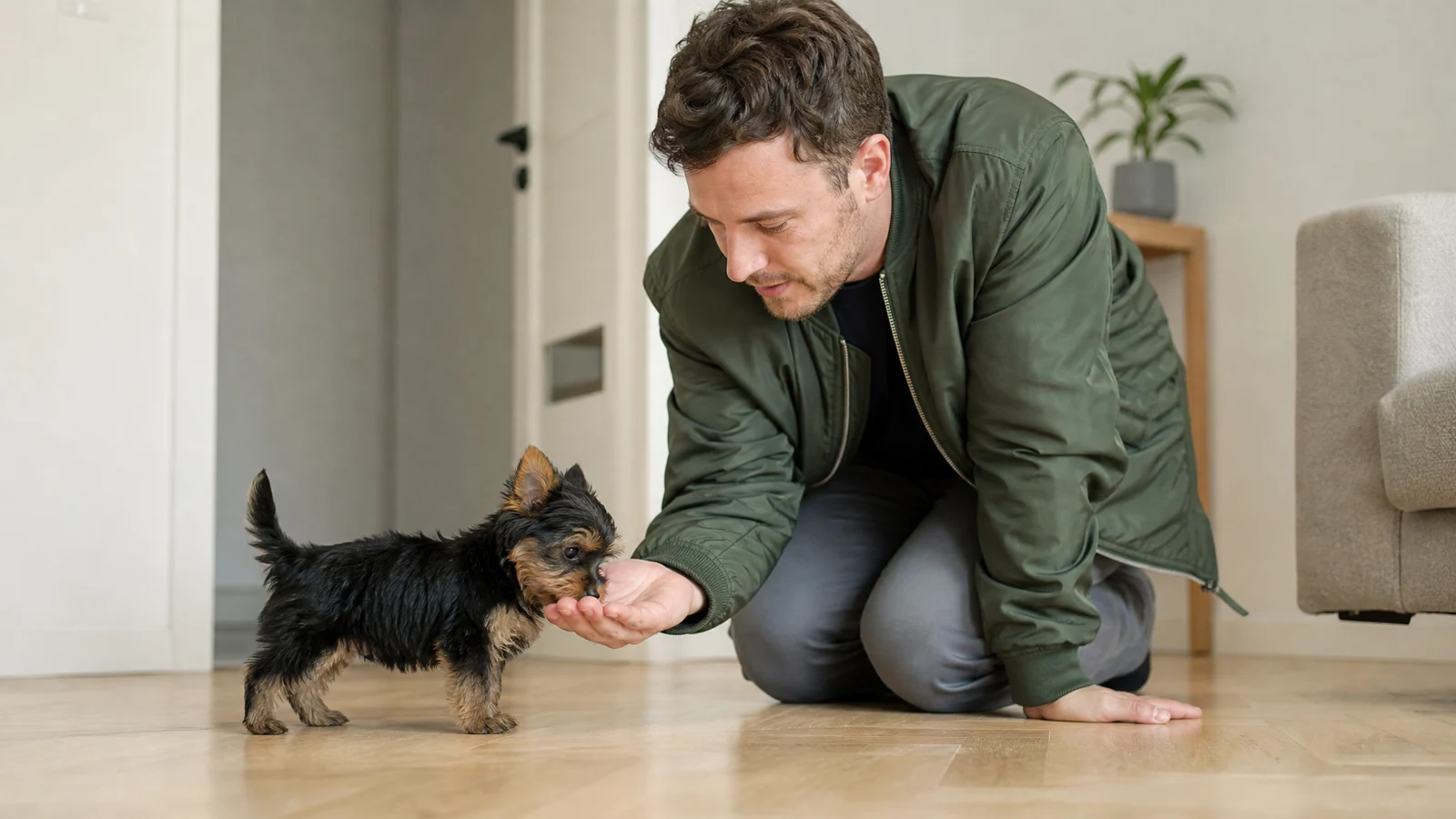
A Yorkie puppy can stride into a room as though the whole place belongs to them, and that swagger is exactly why socializing gets mistaken for something the breed already has covered.
Confidence on the outside says very little about how a puppy feels toward a vacuum cleaner, a stranger's reaching hand or a dog many times their size. Socializing is the teaching that fills that gap: one pleasant, paid-for experience after another, so new things start to mean "safe" and "interesting" instead of "back away." A bold puppy who learns this is easier on everyone, including themselves.
Below, you'll find how to begin before the vet clears the sidewalk, how to handle people and other dogs when your puppy is toy-size, and how to practice sounds and handling at home. We also cover the wary months, because they can surprise even careful owners.
A Bold Yorkshire Terrier Puppy Still Needs Socializing
That swagger is real and breed-deep, which is what makes it so convincing. Yorkies carry a long reputation as feisty little terriers, they usually greet strangers with interest, and they take the watchdog job at the front door seriously, so it is easy to assume a dog like that needs no help meeting the world.
It does need help, because bold and comfortable are two different things. A puppy can march up to a stranger and still flinch at a dropped pan, and a loud bark at a bigger dog can come from a puppy with no idea what to do next.
Socializing builds the missing quality: the calm that lets a puppy meet something new, take it in and bounce back. The method is simple to say and takes patience to do. Pair each new thing with a reward, start at a distance your puppy can handle, and let them leave whenever they want. Quality beats quantity here, because one quiet, pleasant meeting does more good than a pile of overwhelming ones, which can teach a puppy that a whole category is frightening.
That also settles what success looks like. A well-socialized Yorkie is not the dog who greets every person and dog, since expecting everyone to be a friend turns walks into negotiations. The earliest months leave the deepest mark, and puppies generally arrive around eight weeks, so the plan starts the day you bring your puppy home.
Yorkshire Terrier Puppy Socialization Starts Before the Sidewalk
Where socializing can safely start depends on how far along your puppy's vaccine series is, and your veterinarian is the one who knows. Ask at every puppy visit what is safe this week, and treat regular veterinary checkups as part of the socializing plan rather than a separate chore. Until you hear that public places are fine, the work happens at home and in carefully chosen private spaces.
Safe Places to Start Before the All-Clear
Dog parks and pet supply stores are off the list for now, because unvaccinated puppies should avoid public settings so that they are not susceptible to viruses and diseases. A backyard, or the home of a friend or family member, makes a much better classroom.
What does a home classroom look like? Invite one visitor at a time and give them a few treats to toss. Run the vacuum in the next room while your puppy eats. Let your puppy explore a new floor surface or a cardboard box on their own terms. Short, calm and paid for is the recipe, and we take each piece in turn below.
Yorkie Puppy Kindergarten Classes Worth Joining
When your veterinarian gives the go-ahead, a good class offers supervised practice with people and other puppies. Look for one that requires proof of vaccination and meets somewhere easily disinfected, preferably indoors.
Watch a session before you enroll. You want to see treats, toys and praise doing the teaching, puppies free to take breaks, and instructors who match playmates by size, because a toy-size puppy and a rowdy bigger one make a poor pair.
This page offers general training information. Your veterinarian decides when your puppy is ready for public places and classes, so check before each new step.
Introducing a Yorkshire Terrier to New People Without the Scoop
Visitors are the easiest practice to arrange at home, and with a toy-size puppy they come with a built-in hazard: everyone wants to pick the puppy up. Hands descend from above, the cooing starts, and a tiny dog ends up passed around like a party favor.
Please do not hold your puppy out for people to pet, and do not carry them over to a stranger who asks to say hello. A puppy needs the option to say no, and a puppy in someone's arms has lost it. Letting your puppy choose to approach, or to stay put, is what makes a meeting count as practice. Tiny dogs get picked up by default, and we would rather you break that habit on day one.
Visitor Rules for a Toy-Size Puppy
Tell guests these rules before they step inside, and repeat them to anyone you meet outdoors, because the friendliest strangers are often the quickest to reach for a tiny dog:
- Crouch low and let the puppy come to you. A visitor at floor level looms less and leaves room for your puppy to choose.
- Toss treats on the ground rather than handing them over. A puppy who feels unsure can take the food without moving toward a hand, and the visitor becomes someone who makes good things appear.
- Pet only when the puppy comes close and asks. A nudge or a climb into a lap is an invitation, while sniffing from a stretched-out, stiff posture and then backing off is not.
- End the visit while it is still going well. A short break with a treat beats waiting for a tired puppy to complain.
These rules can sound strict for a dog this small, and that is the point: a toy-size puppy has fewer ways to get out of an awkward moment than a big dog does, so people have to give more room.
When Your Puppy Greets Too Hard
Some Yorkie puppies have the opposite problem and fling themselves at every new person. The cure is similar. Tell people "sorry, we're training," and drop treats on the floor as they walk past, so your puppy learns that passersby are a reason to look at you instead of a reason to lunge. If a guest gets jumped on, the guest stands up straight and turns away, and our guide to polite greetings covers the rest.
Socializing With Other Dogs, Big and Small
People are only part of the crowd your puppy has to get used to. Other dogs come in every size, and a Yorkie's big-dog attitude makes meetings with the actual big ones worth planning.
Start by changing what counts as a meeting. A puppy who watches a calm dog from across a yard while eating treats has met that dog, and a puppy who walks past dogs on the sidewalk without greeting any of them has practiced something just as useful. Yorkies tend to do best around other dogs when someone is supervising, which fits this approach, because you control the distance and the duration.
The dog park is a poor classroom for a young puppy, who may become overwhelmed, injured, or learn inappropriate play styles, and size makes that risk easy to picture for a Yorkie. Skip it until your puppy is older and has plenty of calm experience to draw on.
It is also wise not to let your puppy greet unfamiliar dogs on leash. Walk past instead, feeding treats as the other dog goes by, and every passing dog turns into good news. Choose routes and times that make distance easy to manage, and cross the street when a dog is hurrying toward you.
Sounds and Surfaces a Yorkshire Terrier Can Practice at Home
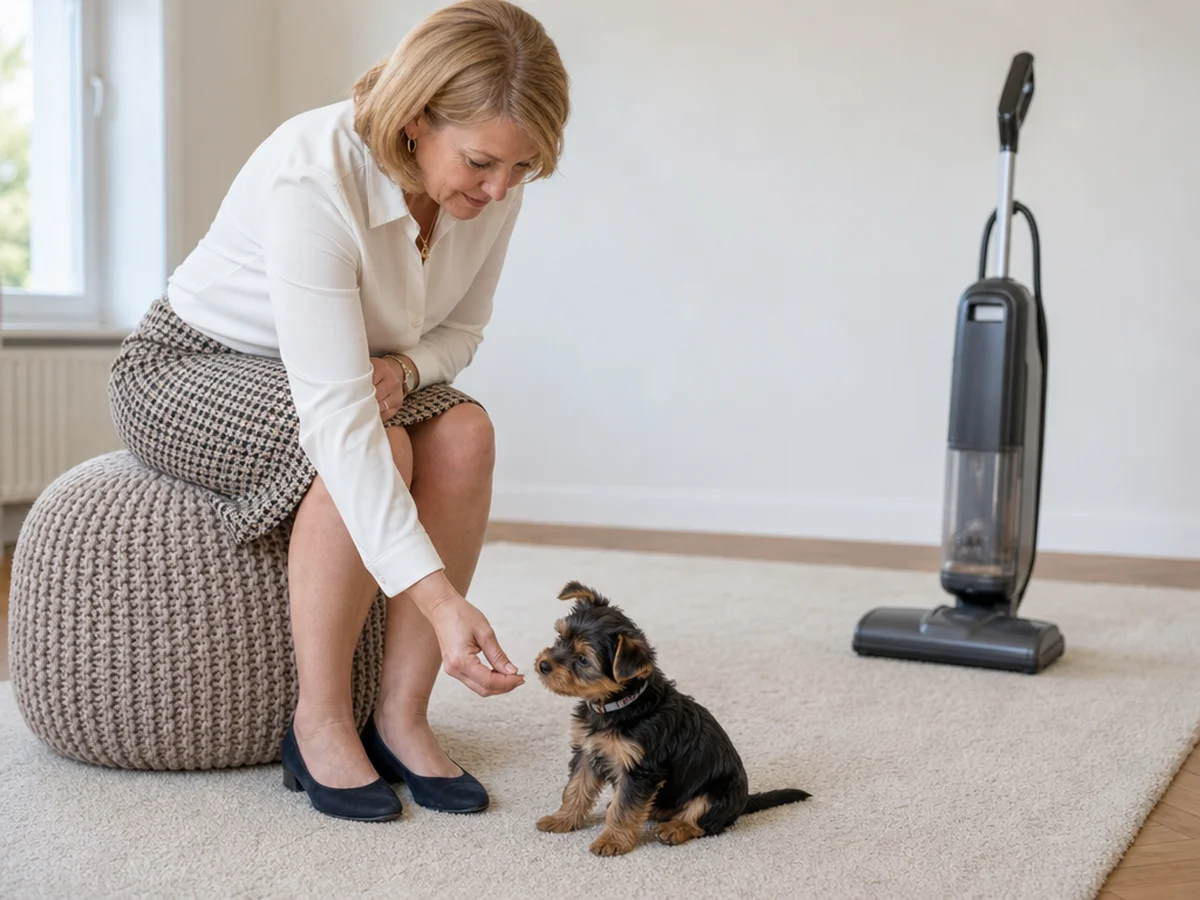
Home practice covers what the sidewalk cannot yet: noises, floors and odd objects that every Yorkie will meet sooner or later. Sounds work best as a treat-pairing game, with a recording or a household noise kept quiet at first and treats flowing for as long as it plays. When the sound stops, the treats stop, which teaches your puppy that the noise predicts something good. Here is the sequence:
- Play the sound at the lowest volume you can manage and start feeding right away.
- Keep the first session very short, and end it while your puppy is still interested.
- Watch your puppy's body. Loose, curious and eagerly eating means you can raise the volume a little next time.
- If your puppy stops eating, stiffens or tries to leave, lower the volume, shorten the session and bring a tastier treat.
A puppy who refuses food entirely is telling you the sound is too loud or the treat is not good enough. Both are easy fixes, and neither means your puppy is a poor candidate for this practice.
Objects and surfaces get the same treatment. Lay a vacuum cleaner on its side on the floor, scatter your puppy's meal or a handful of treats around it, then let your puppy decide how close to get. Over the following days, rotate in a sturdy step stool, a cardboard box, a baking sheet or a tunnel. Anything that could fall or tip stays flat, so nothing can land on a small puppy.
Try not to ask for sits or downs while your puppy explores. The goal is ease around new things, and extra cues turn exploration into a performance. Cues can come back once your puppy walks into new places with confidence.
Handling Practice That Protects Social Confidence
Sounds and objects are about the world around your puppy, while handling is about the hands that will be on them for the rest of their life. A Yorkie's coat means regular grooming, and add vet exams and the occasional stranger's touch, and comfortable handling turns out to be a social skill too.
Start on the chest and shoulders, where most dogs find touch easiest, and keep each touch to a few seconds while your puppy eats a treat. When the treat is gone, the touching stops. That pairing is the whole trick: touch predicts food, and your puppy stays in control by staying or leaving. Ears, paws, tail and lips come later, one at a time, once the shoulders have become boring.
Lip licking, yawning, a stiff body or turning away mean you moved too fast. Go back to an earlier step, because forcing it teaches the opposite of what you want.
Happy visits help too. Once your veterinarian says public places are fine, stop by the clinic lobby or the groomer's door for a treat and a greeting with nothing done to your puppy, then leave. Visits like these take the edge off real appointments, and our grooming practice at home steps carry the same idea onto the grooming table.
Socializing Through the Wary Months
Even a puppy with a flawless start can hit a patch where familiar things suddenly seem questionable, so it helps to know the pattern before it shows up. Puppies go through normal fear periods early on and again in adolescence. A puppy who adored strangers may back away from a delivery driver or stiffen at a dog they met happily last week.
It can feel like a step backward, but it is a normal stretch of development and not a failure of your plan. Respond by making things easier. Move farther from whatever worries your puppy, pay for any calm glance, and once you have created space, ask for a simple behavior your puppy already knows, such as a sit. Never scold a fearful reaction, because scolding adds one more bad thing to the pile your puppy is already weighing.
Keep the practice going at smaller doses. The most sensitive period is short, but the work is not: dogs keep needing pleasant meetings with unfamiliar people, dogs and places well into adulthood, and emotional maturity takes years, not months. A dog who stops meeting new people can lose the idea that strangers are good news.
If your puppy shows intense or constant fear, such as growling, lunging or hiding, call your veterinarian and ask for a referral to a reward-based trainer. Early help is kinder and easier than late help.
Everyday Puzzles for Small Puppies
A few situations come up mainly because your puppy is tiny, and they do not fit neatly into any section above. These are the ones worth settling before they surprise you on a walk.
Is it okay to carry my puppy everywhere?
Carrying is fine as a way out of trouble, such as a crowded sidewalk or a charging dog, but it should not be the default. A puppy carried through every outing never practices walking past a bike or a stranger on their own four feet, and they lose the chance to approach or retreat by choice. Once your veterinarian has cleared public places, set your puppy down in quiet spots and let them explore.
Why does my puppy bark at every passerby?
Yorkies are watchful and fairly vocal by nature, so a puppy who announces every walker is following the breed's script. You do not need to end the watching, only to add a better reaction. When people or dogs pass, drop a few treats on the floor and stay quiet, and your puppy learns that passersby predict food. Our plan for quiet at the window covers the household version of the same idea.
Which dogs make good first friends?
Look for adult dogs who are calm, friendly and vaccinated, ideally ones you know, because the first few dogs set your puppy's expectations. Meet one at a time, beginning with a watch-from-a-distance visit and a few treats, and move closer only when everyone looks loose. Once your puppy is comfortable, add variety in size, coat and energy, so your puppy learns that dogs come in many shapes.
Swagger With Something Behind It
A Yorkie's swagger is part of the charm, and nothing here is meant to take it away. What socializing changes is what sits underneath. A bold front can cover a puppy who is unsure and loud about it, while a dog who has met the world in small, kind steps carries the same strut with ease behind it.
That difference shows when something unexpected walks into the room. Keep the patient, paid practice going through the first year and beyond, and your Yorkie gets to be exactly as bold as they like, because the world no longer feels like something to push back. The strut stays theirs, and the ease is the part you built.
 Puppy trainingYour 8 Week Old Yorkie Puppy: The First Training Week
 Training basicsAre Yorkies Smart? What Intelligence Means for Training
 Exercise and jobsCan a Yorkie Be a Service Dog?